GILSTONES - An innovation in Gemstones
Here to shop our selection? Please visit our STORE
Here to See Spot Price? Please go to our SPOT PRICE page
Gemstones as stores of value?
Gilstones are a new approach to wealth storage that used to only be open to the wealthiest of families. Gemstones have been treasured by Industrial Giants and Captains of Industry. Kings, Queens, Sultans, and Emperors in far off lands have used gemstones as proof of their power and wealth. And, generally speaking, Women love the sparkle and color of gemstones. Even if you won't ever be a tech mogul or marry into a royal family, the staying power and appeal of gemstones have had a timeless relationship with humans as a coveted and useful treasure.
Why haven't Gemstones been used a wealth storage before?
In short, they have. But before the advent of lab grown gemstones and computer aided faceting machines, each gemstone was a unique specimen. Each gemstone was graded along four main characteristics - Carat, Cut, Color, Clarity - Which varied greatly among each stone. Finding gemstones that were of similar characteristics would take great effort across a considerable time scale, increasing the price of matching sets. But with the advent of industrial gemstone crystal production, and with the wonders of computer aided gemstone software and faceting machines, gemstones have begun to enter a new era of possibilities. Gemstones have become a commodity! And a commodity can be readily traded as an interchangeable medium, as each gemstone is nearly identical to the last.
So what are Gilstones?
Gilstones are a commoditization of Gemstones, delivered in a durable package for easy transport and storage. Gilstones contain readily recognizable and difficult to reproduce security features. Gilstones contain gemstones, which have a proven track record as a desirable bartering medium that is accepted across the globe. Gilstones are interchangeably stackable gemstone commodities, ready to meet your needs of wealth storage and transport.
Gilstones currently come in 4 denominations:
Blue Spinel
Yellow YAG
Alexandrite Chrysoberyl
Pink Diamond
What is different between the denominations of Gilstones?
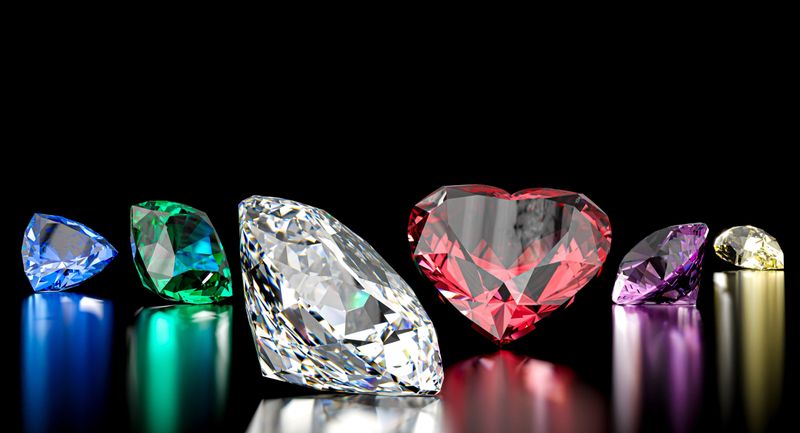
Gilstones come in 4 readily identifiable colored Gemstones. These are the Blue Spinel, The Yellow YAG (or Yttrium Aluminum Garnet), the Alexandrite Chrysoberyl, and the Pink Diamond. These stones were chosen due to their very different color. Adding to this difference, each Gilstone denomination is packaged in a different shape of container, aiding in their ready identification as Gilstones and of what denomination. These different denominations are also valued differently based upon the current retail market price of loose 1 carat gemstones that meet the criteria of Gilstones:
That the gemstone meets the specific criteria for Gilstones
Spinel - 6.5mm Round Cut Deep Blue Synthetic Spinel in natural and artificial light. That also fluoresces a purplish red under longwave UV light
YAG - 7X5 mm Oval Cut Yellow Synthetic YAG in natural and artificial light. That also fluoresces a bright yellow under longwave UV light
Alexandrite - 7X5 mm Oval Cut Blueish Green Synthetic Alexandrite in Daylight, Purplish under Incandescent light, and Red under longwave UV light.
Diamond - between .95 and 1.05 Carat Round Cut Pink Synthetic Diamond under natural and artificial light, that also fluoresces an orange under longwave UV light. Additionally is VS2 or better and Fancy color or better,
How is the spot price of Gilstones calculated
The spot price of Gilstones is determined by the average of the 3 lowest known vendor prices currently available for retail purchase and delivery on the internet that meet the specific criteria for Gilstone Gemstones. The price includes the shipping, taxes, custom fees, and any other costs delivering a single gem to your door. You can see additional information on the Spot Price page of this website. If you know of an internet vendor that should be included in the spot price calculation then please feel free to let us know and we will make an assessment, and if everything checks out, will replace a vendor as required to reach the true spot price. Also feel free to check the prices at the websites mentioned. We aim to be open and transparent when calculating the going rate for Gilstones. Finally, the buyer should be aware that the price of Gilstones will fluctuate based upon the market conditions. This may mean that your Gilstones may go up in dollar value, but can also mean that your Gilstones may go down in dollar value. But, one thing you can say, no matter the price of Gilstones, the beauty and vibrant color of your Gilstone Gemstones will not change, assuming proper care and storage.
What are the security features of Gilstones?
The security features for your Gilstones are many fold. The most apparent security feature uses the inherent and identifiable nature of various gemstone crystal color, namely the color of these gemstones under different light sources. Additionally Gilstones are made up of special and specifically designed shapes with tight tolerances that allow the Gilstones to interchangeably stack in an interlocking pattern. Gilstones also come with holographic labeling and other security features that will become apparent as you explore you Gilstones!
Another great security freature is that all Gilstones will be able to interchangeably stack on top of each other. Try it out and see. All denominations can nest and stack on top of each other denomination.
Why would Gilstones be a hedge against inflation?
Gilstones are a potential hedge against inflation for the simple reason that raw materials, electrical power, and specialized industrial processes and equipment are required to create a commoditized gemstone. As there are tangible costs for direct materials and power consuming equipment to making identical lab grown cut gemstones, the price for gemstones will rise as inflation causes the raw materials, power, and equipment to rise also. However, as the processes become more efficient and through efficiency of scale, there is a chance that the sum total cost of lab grown gemstones may go down, resulting in a reduction of bartering power for Gilstones. Hence we say there is a potential hedge against inflation. Below are two case examples to explore to help you decide which way the market might go. As for us at Gilstones, we believe the staying power of desirable gemstones will continue to keep Gilstones as a valuable commodity for the foreseeable future! At our company we are Sold on Gilstones!
Case Study 1 - Of Pearls and Amethysts
Pearls used to be a very valuable natural gemstone, with the well known barter of the Morton Plant Mansion in New York City for a double-stranded natural pearl necklace. At the time of the trade, those pearls were estimated to be worth over 1 million dollars. But, not too soon after, cultured pearls became a viable route to pearl production, drastically reducing the cost of pearls. By the time those same pearls were auctioned in the mid 1950s, they sold for a (relatively) meager 150 thousand dollars. Industrialized pearl production had drastically increased the supply of pearls which based upon market forces reduced the overall price point of pearls, natural or farmed. However, one should note that the overall demand of pearls has not waned. Pearls are still given as gifts and worn as treasured jewels by many a lady. The simple elegance of a pearl necklace is still a highly sought after accessory for weddings, anniversaries, birthdays, and other fond occasions. And pearls, although a fraction of the price that natural pearls could demand, are still a viable bartering medium during negotiations. Who knows, maybe you could still buy a building with a sufficient quality and quantity of pearls today!
The Amethyst had a similar trajectory. Today Amethyst is classified as a semi-precious gemstone and you can find people who sell them for dollars on the pound. There are Amethyst Geodes the size of buildings, and faceted gemstones for sale larger than your hand. But it was not always this way, In ancient Roman, Greek, Egyptian, and Chinese Civilizations, Amethyst was the color of Royalty and worn by Princesses and Kings. So rare was Amethyst in the old world that it was just as precious as Ruby, Diamond, Sapphire, and Opal. But in the early 19th century HUGE mountains full of Amethyst were discovered in South America. The miners tried to keep the secret but eventually word got out, the rarity of Amethyst was no more, and the bartering power of Amethyst crashed. Its still valuable today as a unique and interesting form of quartz. Art work has been made from Amethyst and it still holds a coveted spot as the February birthstone. But no one would trade an Amethyst for a Ruby, all C's equal.
But here is the kicker, The rarity of lab grown gemstones has already crashed! Lab Grown Diamonds now sell for a 90% discount of the going rate of a mined Diamond. China and India have cracked the production methods for Spinel and Corrundum to produce a carat of quality cut gemstones for less than 5 dollars. So it's the perfect time to start your Gilstone journey. Just as the pearl and amethyst still have bartering power, the rarity crash of Diamonds, Alexandrite, Yag, and Spinel will still hold value that can be bartered with for eons to come, preserving your bartering power.
Case Study 2 - The Penny
In 2025 the American mint ceased making Pennies. The reason they stopped was because it was no longer economically feasible to create the penny due to inflation. The penny, as a unit of value, had lost so much bartering power that the raw materials and labor required to make a penny cost 3.6 cents per penny sold for 1 cent. So even though the American fiat currency as a unit slowly ebbs away at your ability to barter, the raw material costs and the labor, equipment, power, etc costs still cause the relative scarcity of a finished product to be valuable and able to be used to barter. Case in point, here is a thought experiment for you. if you took the raw material of a penny and used the same equipment, labor, and machines, but you stamped something else other than 'penny' onto it, Would you be able to sell it (barter with it) for more than 3.6 cents? In the same way the production costs of Gemstones will always create a value since making new Gilstones also require raw materials, equipment, labor, power, and all of the other necessary costs.
Conclusion:
With Gilstones, we are lucky to not be the base unit of value adopted by the world. Just like Gold and Silver are no longer tied to the dollar and can fluctuate with market forces, so can Gilstones. And since Gilstones can fluctuate with market and production forces, the Gilstones should be inflation resistant. As always decide what is best for you. But at our company, we are sold on Gilstones!